How much does a homemade candle really cost?
Making your own candles costs from a few euros to around twenty euros each. The gap is huge, and it comes down to three things: the size of the candle, the quality of the materials and, above all, the container.
An old jam jar, a decent wax and a good fragrance: you are at a few euros. A beautiful bought container, premium materials and a large size: you climb towards €20.
Here is the breakdown, item by item.
The cost of materials, item by item
The wax
Soy wax costs between €5 and €8 per kilo, depending on the quantity bought. It is the most stable and least expensive item.
For a 160 g candle, that is around €0.80 to €1.30 of wax.
Beware of false economies: paraffin is cheaper, but it is a petroleum derivative. Plant-based waxes (soy, rapeseed, coconut) cost more to buy and completely change the nature of the finished product.
The fragrance
This is where the gap widens. A quality fragrance, certified phthalate-free and CMR-free (substances that are carcinogenic, mutagenic or toxic to reproduction), costs between €80 and €140 per litre. The price varies with the supplier and the volumes ordered.
The dosage matters as much as the price. At OALI, I generally use between 7 and 12% depending on the fragrance: some hold at 7%, others need 12% to diffuse properly.
On a 160 g candle, that represents 11 to 19 g of fragrance, or €1.20 to €2.30.
You can find much cheaper fragrances. They smell strong and cost little, but they offer no guarantee about what you are breathing when you burn them at home. It is the one item where I strongly advise against cutting costs.
The wick
A marginal cost: a few tens of cents per candle.
On the other hand, it is the item where mistakes cost the most in failed candles. A wick that is too thin tunnels into the wax; one that is too thick smokes and overheats the container. The right size depends on the diameter of the pot, the type of wax and the fragrance load. You find it by trial and error.
The container
The most variable item, and the one that explains almost all of the price gap.
A reused jam jar, an upcycled jar, an odd glass: zero euros. It is the simplest way to bring down the cost of a homemade candle, and also the most consistent if your approach is eco-friendly.
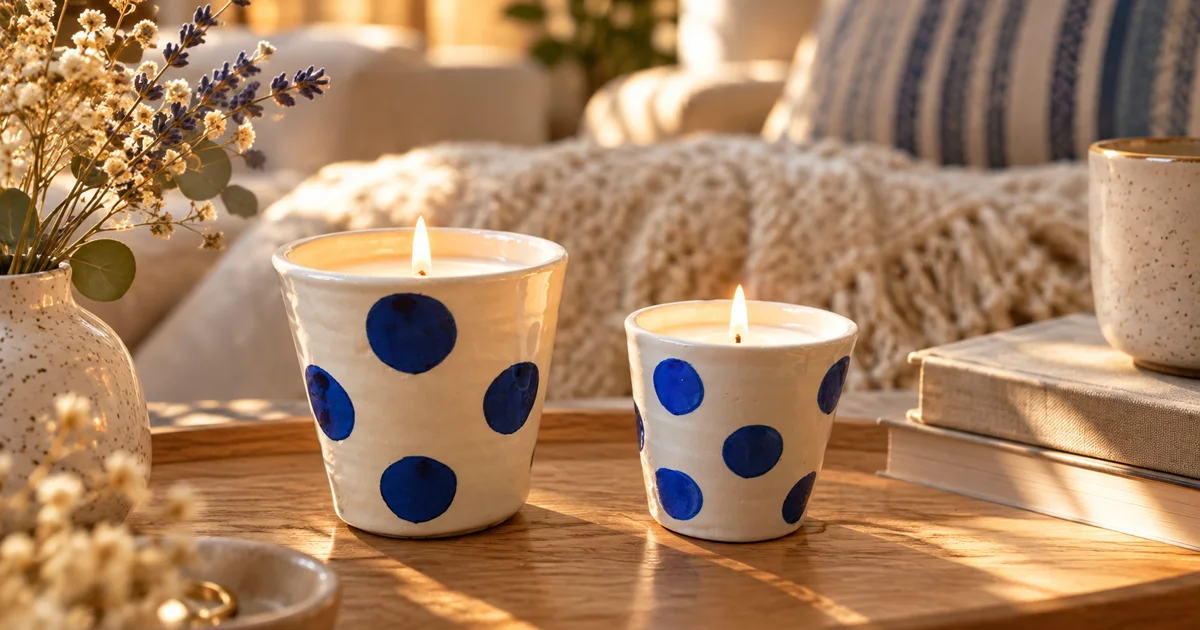
A shop-bought container costs a few euros. A handmade ceramic, shaped and painted by hand, costs several times that.
And size, which multiplies everything
A 160 g candle and a 320 g candle don't cost the same: the wax and fragrance double, and so does the container. When you compare two prices, always check the weight before drawing conclusions.
What the homemade calculation leaves out
Add it up: wax, fragrance, wick, container. You get a material cost. But that is not the real cost of your first candle.
Equipment. A melter or double boiler, a thermometer, precision scales, measuring jugs, wick holders. Allow €50 to €150 to get started. Spread over ten candles, it changes everything; spread over two, it doubles the price.
Electricity. Melting wax takes time, and it has to be kept at temperature throughout pouring. On a single candle, it is negligible. Over a whole day of production, it shows on the bill.
Cleaning. If you are organised, all goes well, but one slip and… oops. Wax spilt on the worktop or the floor is greasy: it sets, it sticks and it won't come off with an ordinary sponge. You have to scrape it, use very hot water and sometimes start again. Count that time in your real cost, and protect your surfaces before you start rather than after.
Failures. First attempts are not always very successful: a cracked surface, a badly sized wick, a fragrance that doesn't hold when burning, wax pulling away from the sides. That is normal, and it is the real cost of learning.
Time. A candle can't be poured in one go if you want a smooth surface. You have to pour in several stages, wait between each, trim the wicks, then let them cure for several days before knowing whether the result holds up.

Why a professional handmade candle costs more
The question comes up often: if the materials cost €5, why does the candle sell for €30?
Because materials are only a fraction of the real cost. And because a maker needs to pay themselves a salary, which is almost always forgotten.
Working time. This is the biggest and most invisible item. Designing the models, testing fragrances, negotiating with suppliers, pouring, trimming, curing, testing, packing, shipping, answering customers, doing the accounts. A candle is not an object that comes out of a machine: it is several hours of human work spread over weeks. If that time is not in the price, the maker is working for free.
Here is what comes on top.
Packaging and shipping. The most underestimated item. Labels, boxes, protective materials, parcels, shipping costs. For a ceramic object, protection is not optional.
Breakages. They happen. You have to count insurance costs, and the real cost of breakages when a parcel doesn't arrive in one piece. This cost is invisible on one candle and very real on a thousand.
Transaction fees. Every order goes through Stripe, PayPal or another payment processor. A commission is taken on every sale.
Everything else. Website, advertising, packaging. Everything that can't be seen in the finished product but exists in the price.
Taxes. Part of the displayed price goes straight to VAT. And what remains as profit is then taxed. In other words: the maker doesn't pay themselves from the selling price, but from what remains once all costs have been deducted, and then pays tax on that share too.
And retailers' margins
This is the part nobody explains, and it deserves to be said clearly.
When a handmade candle is sold in a shop, the ratio between the shop's displayed price and the price actually received by the maker generally ranges from ×1.8 to ×3. In my experience, almost no shop agrees to stock a product if its ratio is below 2.3.
In other words: the shop's margin is higher than the maker's.
This is not about denouncing an injustice. A shop pays rent, staff and overheads, and takes the risk of unsold stock. Its margin funds all of that.
But you need to have that figure in mind to understand a price in a shop window. And to know that from what comes back to the maker, all the costs described above still have to be deducted.
The concrete case of an OALI candle
To give an idea of the real time involved, here is what lies behind a single candle.
It all starts with the pots. I design the patterns, then work on them with the Moroccan cooperative that produces my ceramics. We test, I correct, we adapt. Once production is under way, it takes three to four months: a first firing in the kiln, a second after painting, drying in the sun, then transport from Morocco to Belgium.
In parallel, the fragrances. I only test healthy fragrances, certified free from CMR substances and phthalates, with transparent and verifiable composition information. Out of around thirty fragrances tested, I keep one.
Production only starts once the pots arrive. I work in batches, on long pouring days of ten to twelve hours. Each candle is poured in several stages to get a smooth surface. Then: trimming the wicks, at least three days of curing, then testing the final result.
Only then does the candle go on sale.
So, should you make your own candles?
Yes, if it is for the pleasure of making. Pouring your own candles is accessible and satisfying, and gives you total control over what you burn at home. Start with a simple container, soy wax and a certified fragrance, and accept that the first ones will fail.
Yes too, if you reuse your containers and make a lot of them. By spreading the cost of equipment and reusing jars, you get down to a few euros per candle. The saving is real, as long as you get past the first failures.
No, if you count your time. Between wick trials, pouring in several stages and the days of curing, a candle takes hours spread over a week. And you won't get the same object as a piece shaped by a ceramicist.
The real question is not the price. It is knowing what you want: to make something, or to own something you can't make.
At OALI, each candle is hand-poured in Belgium and France, in soy wax, with fragrances from Grasse free from phthalates and CMR substances, in a hand-shaped, hand-painted ceramic pot. Once the candle has burnt down, the seed paper label is planted in the pot and grows wildflowers.